24/7 Security Operations Center (SOC): Strengthening Cyber Resilience in Banking & Finance
May 29, 2025
Resilience isn’t just a goal it’s a necessity. As the Middle East's banking sector accelerates digital transformation, institutions are exposed to an unprecedented rise in cyber threats. One private financial organization, undergoing aggressive digital expansion, found itself facing that very challenge: how to protect its operations, clients, and data in a constantly evolving threat environment.
This is the story of how a forward-looking financial entity transformed its fragmented and reactive cybersecurity posture into a unified, intelligence-driven defense model through the strategic integration of a 24/7 Managed Security Operations Center (SOC).
The Rising Storm: Context and Challenges
Operating across multiple regions in the Gulf, the institution had embraced cloud services, digitized customer-facing platforms, and onboarded third-party vendors to support growth. But these advancements came at a cost a drastically expanded attack surface and growing compliance burdens.
Key Challenges Included:
1. Cyber Insurance Compliance Pressures
Cyber insurers now demand more than just firewalls and antivirus tools. To remain insurable and reduce premium costs, the organization needed active threat detection, rapid response mechanisms, and demonstrable threat intelligence capabilities.
2. Disjointed Security Tools
Patch Management (PM), Vulnerability Management (VM), and Endpoint Detection & Response (EDR) tools were operating in isolation. This created alert fatigue, context gaps, and long response times for security incidents.
3. Limited Internal Expertise
The internal IT team, while efficient in routine tasks, lacked 24/7 monitoring coverage, advanced threat hunting, and forensic investigation capabilities putting them at a disadvantage during critical threats.
4. Regulatory and Audit Readiness
With compliance reviews on the horizon, the institution lacked centralized log management, structured incident response protocols, and consolidated threat reports key elements of passing audits and demonstrating cyber maturity.
The Turning Point: Choosing a Managed SOC Approach
Recognizing the limitations of a piecemeal defense model, the institution opted to partner with a Managed SOC provider a move designed to introduce centralized threat visibility, expert-led response capabilities, and strategic alignment with both regulatory frameworks and cyber insurance mandates.
The goal was not just to install another tool, but to embed a mature security operations model into the organization’s DNA.
The Strategy: Building a Tailored SOC for a Hybrid Financial Ecosystem
The Managed SOC solution was engineered specifically for the client’s hybrid infrastructure seamlessly bridging on-premise systems and cloud-based services. It wasn’t just about technology, but about combining the right tools, people, and processes to deliver measurable risk reduction.
Key Components of the Managed SOC Deployment:
🔹 24/7 SOC with Next-Gen SIEM Integration
A centralized SOC environment was established with a next-generation Security Information and Event Management (SIEM) platform. Real-time alerts, global threat intel feeds, and custom correlation rules ensured timely detection and actionable insights.
🔹 Unified Visibility Across All Security Tools
The SOC aggregated telemetry from PM, VM, and EDR platforms normalizing disparate data sources into a single pane of glass. This eliminated blind spots and drastically reduced noise from false positives.
🔹 Proactive Threat Hunting and MITRE-Aligned Response
Advanced incident response playbooks were developed based on the MITRE ATT&CK framework. The SOC team (Tier 1 to Tier 3 analysts) provided real-time investigation, root cause analysis, and hands-on threat containment.
🔹 Cyber Insurance Readiness Reporting
Monthly SOC reports were designed to map directly to cyber insurance risk criteria, ensuring transparency and maintaining eligibility for favorable insurance terms.
🔹 Compliance and Executive Reporting
The SOC solution came with executive dashboards and board-level reporting templates featuring critical KPIs such as MTTD (Mean Time to Detect) and MTTR (Mean Time to Respond) essential for compliance audits and governance reviews.
The Results: A Resilient, Intelligence-Driven Security Posture
In just a few months, the financial institution experienced a fundamental shift in its cybersecurity capabilities from reactive patchwork to proactive defense.
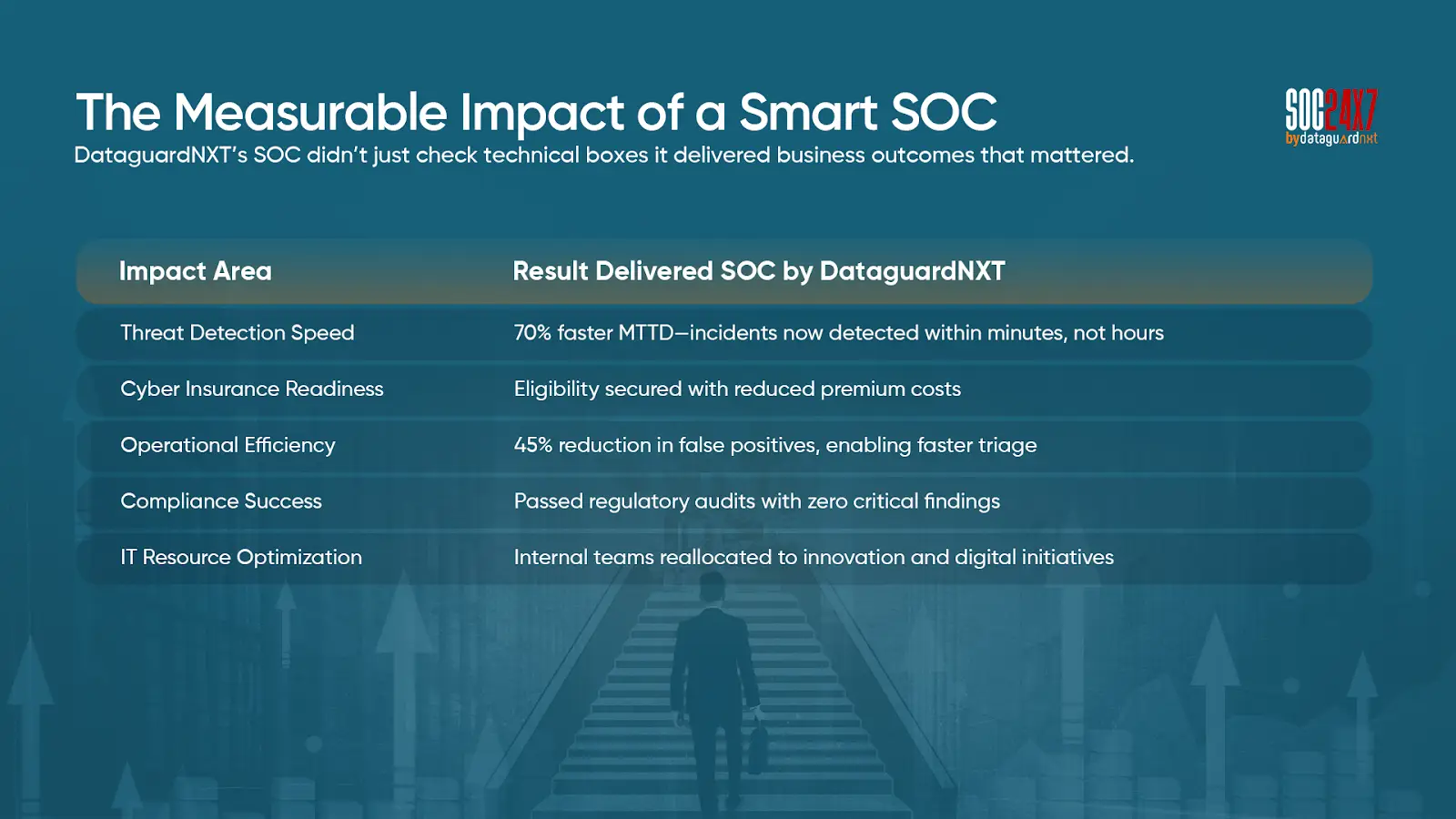
Final Outcome: A Scalable Blueprint for Financial Cybersecurity
By adopting a fully managed SOC solution, this institution achieved more than just compliance it gained confidence, agility, and resilience. The centralized SOC became the heartbeat of its security operations, enabling rapid response to real threats, clarity in regulatory reporting, and peace of mind in an ever-evolving digital landscape.
Why This Matters to Financial Institutions
- Cyberattacks on banks are growing in frequency and complexity
- Regulators now demand continuous monitoring and actionable threat insights
- Cyber insurance costs are rising without proof of robust cyber hygiene
- Internal IT teams are overwhelmed without round-the-clock SOC coverage
This case proves that a Managed SOC is no longer a luxury it’s a necessity for financial institutions that aim to scale securely in the digital age.
Ready to Strengthen Your Cyber Resilience?
A fragmented cybersecurity approach can leave your institution vulnerable. A Managed SOC, tailored to your infrastructure and industry, offers the visibility, response, and compliance alignment your business needs to thrive.
Experience the power of continuous protection with Managed SOC.
Let’s build your cyber fortress starting today.